
 (331) 234-9900


 Sign In
 304 vs. 420 Stainless Steel: The ultimate comparison


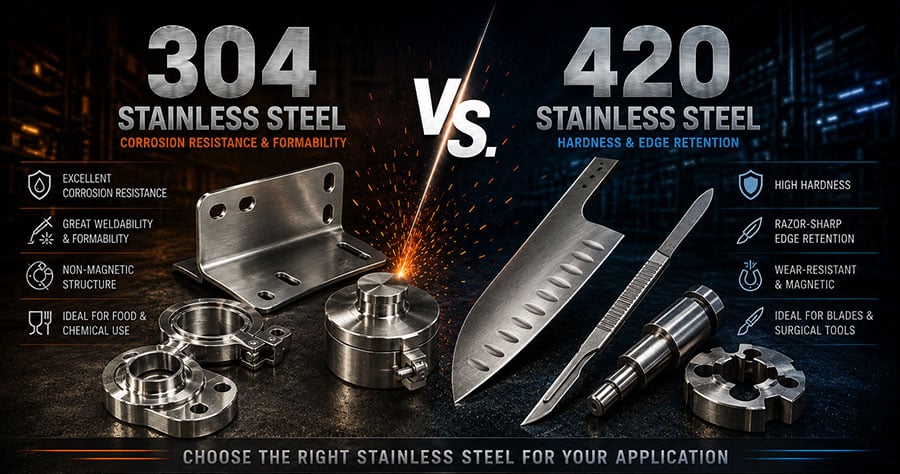
When choosing, it ultimately comes down to the properties of the individual grades 304 vs. 420, in this case it is corrosion resistance versus hardness.
Table of Contents
- Chemical composition 304 vs. 420
- Summary of effects of alloying elements
- Typical application scenarios
- The Quick Guide to choosing the right grade
- What applications can each steel grade be used for?
- What are the similarities and differences of AISI 304 and AISI 420?
- Considerations and Limitations of 304 and 420 stainless steel
- Mechanical properties for 304 vs 420
- 304 vs 420: When you should trade corrosion resistance for edge hardness
- Decision Checklist: Which material should you order?
- Weldability of the steel grades compared
- Conclusion
- Frequently Asked Questions
Chemical composition 304 vs. 420
| Alloying element | 304 ( X5CrNi18-10 ) | 420 ( X46Cr13 ) | Effect |
|---|---|---|---|
| Carbon (C) | 0 - 0.07% | 0.43 - 0.5% | Hardness vs Toughness |
| Silicon (Si) | 0 - 1% | 0 - 1% | Oxidation vs. Flow |
| Manganese (Mn) | 0 - 2% | 0 - 1% | Deoxidation & Strength |
| Phosphorus (P) | 0 - 0.045% | 0 - 0.04% | |
| Sulfur (S) | 0 - 0.015% | 0 - 0.015% | |
| Chromium (Cr) | 17.5 - 19.5% | 12.5 - 14.5% | Corrosion vs. Wear |
| Nickel (Ni) | 8 - 10.5% | residual | Ductility vs. Hardness |
| Molybdenum (Mo) | 0 - 0.11% | residual | Strength vs. Pitting |
Summary of effects of alloying elements
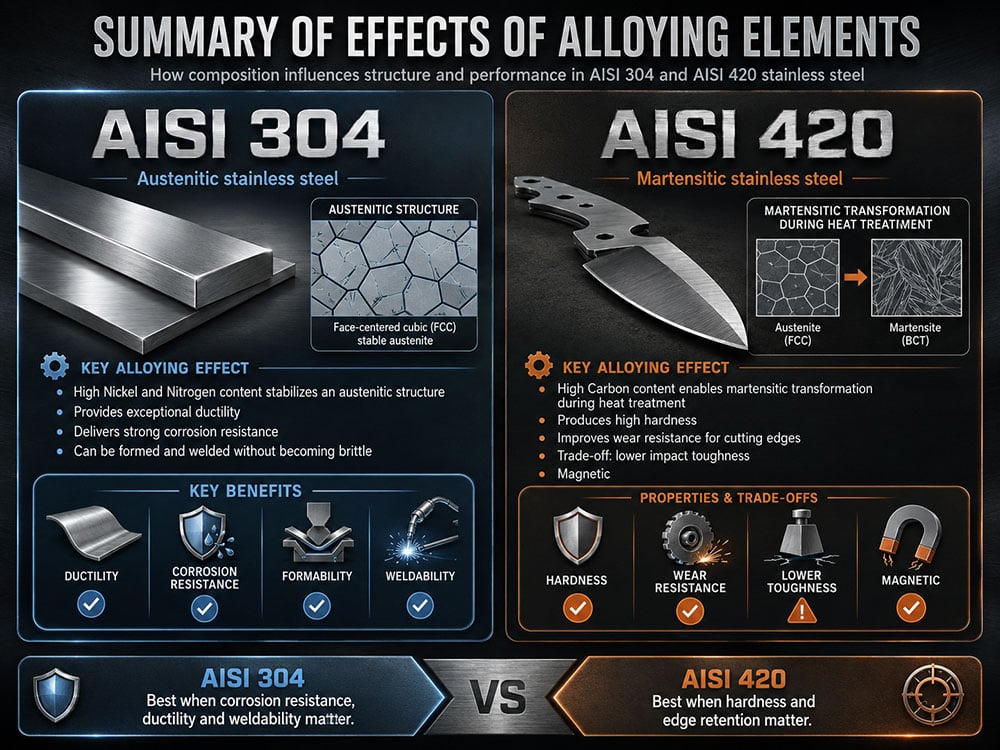
AISI 304: The high Nickel and Nitrogen content stabilizes an austenitic structure, providing exceptional ductility and corrosion resistance that allows the steel to be formed and welded without becoming brittle.
AISI 420: The high Carbon content enables a martensitic transformation during heat treatment, producing high hardness and wear resistance for cutting edges at the expense of lower impact toughness and magnetism.
Typical application scenarios
| Scenario | Recommended Grade | Why |
|---|---|---|
| Commercial Kitchen Equipment | 304 | High Nickel and Chromium provide the food grade corrosion resistance needed to withstand constant moisture and acidic cleaners. |
| Professional Cutlery and Blades | 420 | The high Carbon content allows the steel to be hardened to 50 - 55 HRC, ensuring a sharp, long-lasting cutting edge. |
| Chemical Storage Tanks | 304 | Excellent weldability and ductility allow for the fabrication of large, leak proof pressure vessels that won't crack under stress. |
| Surgical Instruments | 420 | Combines functional rust resistance with high abrasion resistance, allowing scalpels and forceps to remain precise after repeated use. |
| Architectural Trim & Piping | 304 | Its austenitic structure makes it non magnetic and highly aesthetic, maintaining a mirror like finish even in outdoor environments. | Mechanical Fasteners & Shafts | 420 | Higher tensile strength and hardness after heat treatment make it ideal for parts subjected to high torque or sliding friction. |
The Quick Guide to choosing the right grade
Choose 420 steel if you are designing tools that require a high degree of hardness, need a razor sharp cutting edge that resists dulling, or if the part must endure high levels of abrasive wear and sliding friction in a mechanical assembly.
What applications can each steel grade be used for?
| Typical application | 304 | 420 |
|---|---|---|
| Kitchenware | Professional cookware and sinks | High quality chef’s knives and cleavers |
| Medical | Laboratory benches and IV stands | Surgical scalpels and dental explorers |
| Fasteners | Non magnetic bolts and washers | High tensile screws and spring clips |
| Industrial | Chemical storage and pressure vessels | Heavy duty pump shafts and valve parts |
| Food Processing | Milk and beverage pasteurizers | Meat grinders and industrial slicers |
| Architecture | Decorative cladding and handrails | High wear hinges and latch mechanisms |
| Automotive | Exhaust manifolds and trim | Hardened brake discs and needle valves |
| Tools | Measuring cups and funnel sets | Precision tweezers and scraper blades |
| Marine | Fittings for freshwater environments | Hardened propeller shafts and gears |
| Appliances | Refrigerator interiors and drums | High speed blender blades and cutters |
What are the similarities and differences of AISI 304 and AISI 420?
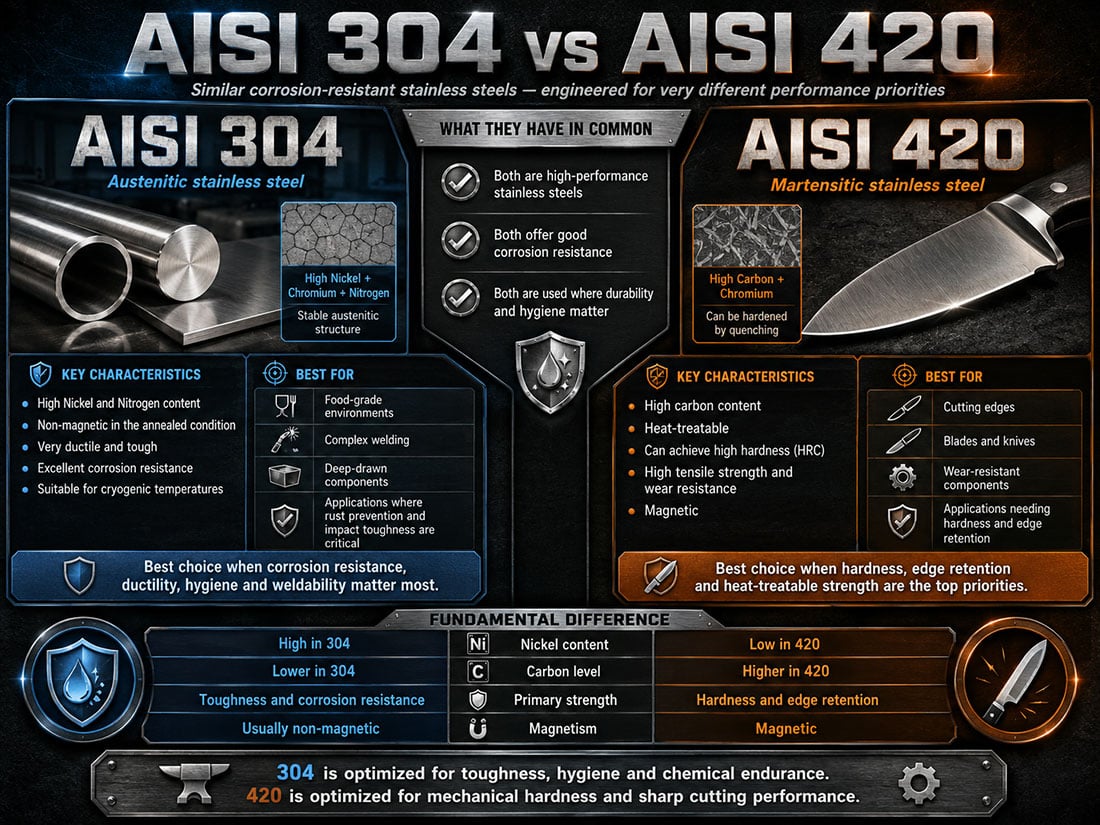
This dictates whether the steel is optimized for extreme structural toughness and hygiene or for achieving an exceptionally hard, heat treatable cutting edge.
Grade 304 is formulated with high Nickel and Chromium for maximum chemical endurance, whereas 1.4034 (420) remains the gold standard for mechanical hardness and edge retention in the 400-series.
304: A versatile austenitic stainless steel that utilizes high Nickel and Nitrogen content to maintain a non magnetic, ductile structure even at cryogenic temperatures. It is the preferred choice for food grade environments, complex welding, and deep drawn components where rust prevention and impact toughness are non-negotiable.
Considerations and Limitations of 304 and 420 stainless steel
304 (1.4301): This grade is the premier choice for achieving maximum rust protection and structural reliability in welded assemblies, but its austenitic structure means it cannot be hardened by heat treatment. It should be avoided for cutting tools, gears, or high wear surfaces, as the material is inherently "gummy" and will deform or gall under abrasive loads rather than maintaining its shape.
420 (1.4034): This alloy offers an exceptional ability to reach high Rockwell hardness and provides excellent edge retention, though its high Carbon content makes it highly susceptible to corrosion if not properly hardened and polished. While it excels in blades and surgical instruments, its restricted weldability and tendency toward brittleness must be factored into the design phase; unlike 304, it can snap under heavy impact and requires precise pre-heating if any welding is attempted.
Mechanical properties for 304 vs 420 Steel
| Properties | 304 | 420 |
|---|---|---|
| Tensile strength | 100.0 KSI | 118.2 KSI |
| Working hardness | 195 - 215 BHN (on delivery) | 50 - 55 HRC |
| Allowable working temperature | 68 - 392°F (20 - 200°C) | 68 - 392 °F (20 - 200°C) |
| Machinability | two of six ⭐️⭐️★★★★ | four of six ⭐️⭐️⭐️⭐️★★ |
| Toughness | six of six ⭐️⭐️⭐️⭐️⭐️⭐️ | three of six ⭐️⭐️⭐️★★★ |
| Wear resistance | one of six ⭐️★★★★★ | four of six ⭐️⭐️⭐️⭐️★★ |
| Corrosion resistance | six of six ⭐️⭐️⭐️⭐️⭐️⭐️ | five of six ⭐️⭐️⭐️⭐️⭐️★ |
304 vs. 420: When you should trade corrosion resistance for edge hardness
This comparison helps to understand the difference in chemical resilience versus mechanical performance:
304 is like a stainless shield: It is incredibly tough and reliable in the face of environmental attack. Because its high Nickel content creates a stable, non magnetic structure, it can be bent, welded, and exposed to harsh cleaners without failing or rusting. This makes it the safe choice for hygiene and structural integrity, but it is too soft to ever hold a sharp cutting edge.
420 is like a surgical blade: It is capable of achieving a level of hardness and precision that is unmatched in the stainless family. When heat treated, the high carbon content allows for a microscopic, razor-like edge that resists wear. However, that same internal rigidity means it lacks the stretch of 304; if subjected to heavy impact or extreme bending, the material can snap rather than deform.
| Feature | 304 (The "Tough" one) | 420 (The "Hard" one) |
|---|---|---|
| Hardening Ability | None. Cannot be hardened by heat; stays soft and ductile for forming. | High. Can be quenched and tempered to reach 52 - 56 HRC for tools. |
| Corrosion Resistance | Excellent. High Nickel / Chromium balance prevents pitting in most chemicals. | Moderate. Provides functional rust resistance, but requires polishing to stay clean. |
| Impact Toughness | Extreme. Will dent or deform under heavy shock rather than breaking. | Limited. Its hardened structure is brittle and may chip or snap under impact. |
| Total Cost of Ownership | Lower maintenance for parts exposed to water, salt, or cleaning agents. | High performance for tools where edge retention and wear resistance are vital. |
Decision Checklist: Which material should you order?
Yes: Choose 304 (its austenitic structure offers extreme ductility and excellent weldability without the risk of the material snapping or cracking).
2. Are you designing surgical instruments or precision dental tools that must be both hard and stainless?
Yes: Choose 420 (it provides the unique "surgical blade" balance of functional corrosion resistance and a high honed, rigid edge).
3. Is the primary goal to maintain a food grade sanitary finish in a high moisture environment?
Yes: Choose 304 (this grade is the industry standard for food and beverage processing due to its superior, self healing passive layer and non magnetic properties).
4. Is the component a mechanical shaft, valve, or fastener subjected to high torque and sliding friction?
Yes: Choose 420 (the martensitic structure provides the high tensile strength and wear resistance required to prevent mechanical deformation under load).
5. Does the part need to remain non-magnetic for electronic or specialized medical applications?
Yes: Choose 304 (unlike the 400-series, 304 is non magnetic in its annealed state and will not interfere with sensitive magnetic fields).
Weldability of the steel grades compared
| Criteria | 304 | 420 |
|---|---|---|
| Preferred for welding? | Yes; it is the industry standard for welded stainless structures. | No; extremely high risk of cracking and localized brittle zones. |
| Key precautions | Manage heat to avoid sensitization (weld decay) and maintain corrosion resistance. | Mandatory pre-heating (200 - 300°C) and post-weld heat treatment to prevent snapping. |
| Filler choice | Low carbon fillers designed to prevent intergranular corrosion. | Specialized fillers depending on whether hardness or ductility is the goal. |
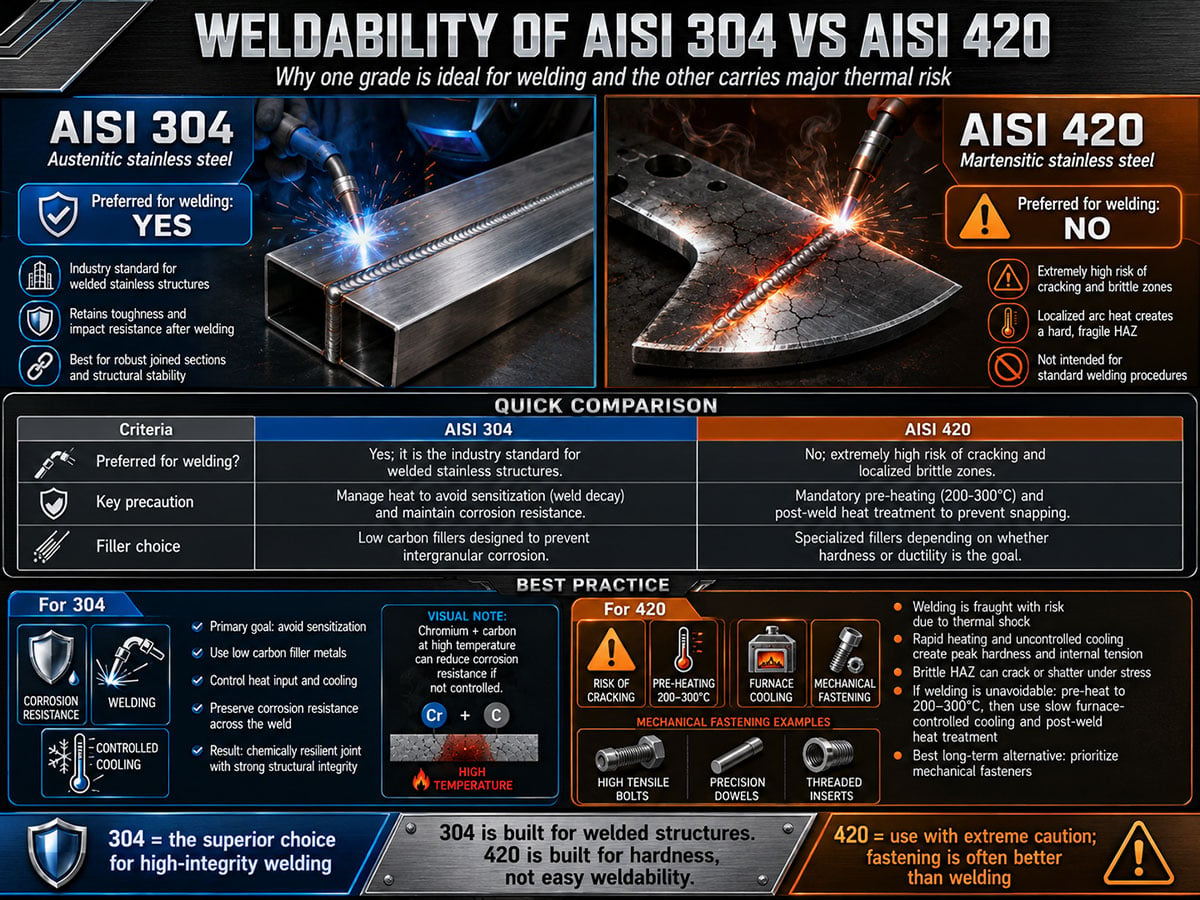
When your application demands robust joined sections or high structural stability, 304 is the superior candidate. Its austenitic nature makes it naturally conducive to welding, as the material retains its characteristic toughness and impact resistance after the thermal cycle. Conversely, 420 is not intended for standard welding procedures. As a high carbon martensitic grade, the localized heat from the arc triggers an intense hardening effect, resulting in a brittle Heat Affected Zone (HAZ) that is highly prone to cracking or sudden failure under stress.
For 304, the primary technical goal is to avoid sensitization, where chromium and carbon react at high temperatures to compromise the alloy's rust proof properties. By utilizing low carbon filler metals and controlled cooling, the joint remains as chemically resilient as the surrounding plate.
Conclusion
Opt for 304 when you are producing food grade equipment, chemical storage tanks, or architectural components that require maximum ductility, ease of welding, and superior resistance to harsh environmental cleaning agents.
Select 420 for high quality cutlery, surgical instruments, and mechanical wear parts where a razor sharp, heat treated edge and high tensile strength are more critical than long term high impact endurance or non magnetic properties.
Whether you value the stainless shield reliability of austenitic 304 or the surgical blade precision of martensitic 420, matching the grade to your specific hardening requirements and environmental exposure is the key to a successful project.
Frequently Asked Questions: 304 vs. 420 Stainless Steel
No. Although 420 is stainless steel, its high carbon content and lower chromium content make it less corrosion resistant than 304. For maximum corrosion resistance, 420 must be fully hardened, tempered, and polished to a high gloss.
2. Can you harden 304 stainless steel through heat treatment?
304 is an austenitic stainless steel, which means that its crystal structure does not change when heated or cooled. This stainless steel can only be hardened through “cold working” (such as rolling or drawing), whereas 420 is specifically designed to be hardened through conventional heat treatment involving quenching and tempering.
3. Why is 304 stainless steel non-magnetic while 420 is magnetic?
The magnetic properties of steel are determined by its microstructure. 304 has an austenitic structure (due to its nickel content), which is non magnetic. 420 has a martensitic structure, which is highly magnetic. This makes 304 the better choice for electronic enclosures or sensitive medical environments such as MRI rooms.
4. Which grade is better for kitchen applications?
That depends on the specific product. 304 is the industry standard for food grade surfaces, sinks, and pots, as it does not rust when exposed to salt or acidic foods. However, 420 is preferred for professional grade cutting tools and blender blades, as 304 is too soft to maintain a keen edge.

Steel Expert • International Business • Digital Strategy
Since 2011, Patrice Gilliland has been actively shaping the international steel market as part of ABRAMS Industries®. She plays a key role in market development in the EU, the UK, and the US, as well as in the digital transformation of sales channels.