
 (331) 234-9900


 Sign In
 1018 vs. A36 Steel: Which Mild Steel Grade is Best for Your Project?


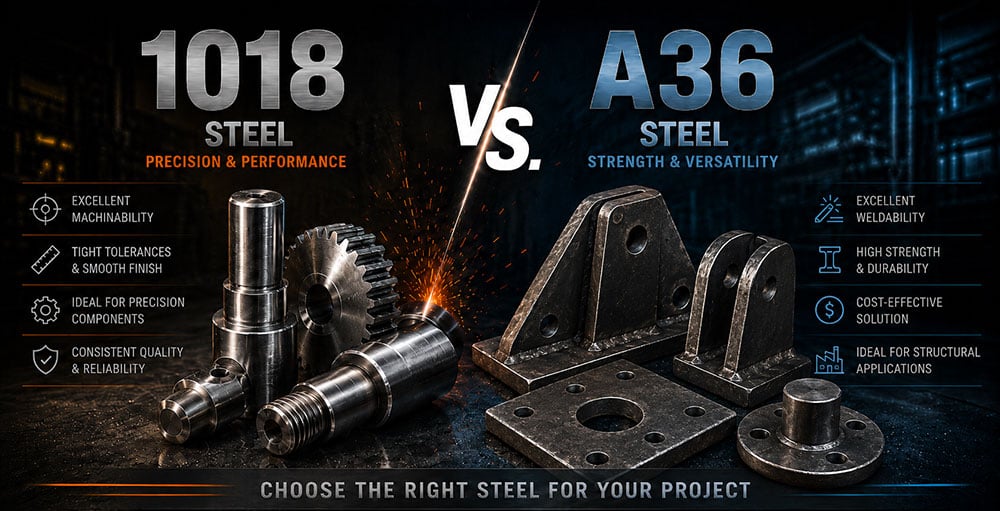
They are frequently used for similar general-purpose applications and can serve as practical alternatives to one another, provided that the required mechanical properties are taken into account.
Table of Contents
- Chemical composition 1018 vs A36
- Summary of effects of alloying elements
- Typical application scenarios
- The Quick Guide to choosing the right grade
- What applications can each steel grade be used for?
- What are the similarities and differences of 1018 vs A36?
- Considerations and Limitations of 1018 vs A36 tool steel
- How are these steel grades produced?
- Comparison of Hot Finish vs Cold Finish
- 1018 vs. A36: When to Trade Precision for Structural Power
- Decision Checklist: Which material should you order?
- Weldability of the steel grades compared
- Conclusion
- Frequently Asked Questions
Chemical composition 1018 vs. A36
| Alloying element | 1018 | A36 | Effect |
|---|---|---|---|
| Iron (Fe) | 98.81 - 99.26% | 99% | Base metal |
| Carbon (C) | 0.18% | 0.25 - 0.29% | Hardness vs Weldability |
| Manganese (Mn) | 0.6 - 0.9% | 0.75% | Strength & Ductility |
| Phosphorus (P) | max. 0.04% | max. 0.04% | Fluidity vs Brittleness |
| Sulfur (S) | max. 0.05% | max. 0.05% | Machinability |
Summary of effects of alloying elements
A36 steel (~1.0045): The slightly higher and more variable carbon and manganese content is primarily designed to achieve a minimum yield strength of 36,000 psi. This chemical composition promotes structural integrity and excellent weldability in the ‘as-rolled’ condition, although the higher carbon content compared to 1018 results in slightly increased hardness and reduced ductility.
Typical application scenarios
| Scenario | Recommended Grade | Why |
|---|---|---|
| Precision Machine Shafts & Pins | 1018 | The tight dimensional tolerances and smooth finish of cold rolled 1018 minimize the need for heavy machining and ensure a precise fit. |
| Heavy Structural Frames & Girders | A36 | Due to its good weldability and cost effectiveness for large section profiles, A36 is regarded as the industry standard in the construction sector. |
| Case-Hardened Gears & Ratchets | 1018 | Its low, consistent carbon content makes it ideal for carburizing, which creates a rock hard outer ‘shell’ whilst the core remains ductile and shock absorbing. |
| Base Plates & Mounting Brackets | A36 | For parts that only require simple drilling and welding, A36 provides the necessary strength without the price premium of a cold finished bar. |
| Automotive Components (Tie Rods) | 1018 | The material is characterised by an excellent balance of strength and ductility; it can be cold formed or bent into specific shapes without cracking or developing surface cracks. |
| General Purpose Fabrication | A36 | This is the most versatile and widely used ‘mild steel’ for everyday workshop projects where high precision tolerances are not a priority. |
The Quick Guide to choosing the right grade
Choose A36 (~1.0045) if you are manufacturing large structures, frames or brackets where cost effectiveness is a priority, where the design requires extensive welding work on thick sheets and corner profiles, or where the precise dimensional accuracy of the raw material is less important than the guaranteed minimum yield strength of the material.
What applications can each steel grade be used for?
| Typical application | 1018 | A36 |
|---|---|---|
| Construction | High accuracy threaded rods and studs | Heavy duty I-beams, channels and angles |
| Machining | Precision turners, bushings and spacers | Rough cut mounting plates and base stands |
| Fasteners | High quality cold headed bolts and pins | Large welded anchor bolts and tie rods |
| Industrial | Hydraulic cylinder shafts and hydraulic rams | Heavy equipment frames and storage racks |
| Automotive | Splined shafts, tie rods, and steering components | Chassis reinforcements and truck bed frames |
| Infrastructure | Precision rollers for conveyor systems | Bridge plates, guardrail brackets and walkways |
| Tools | Die sets, mold bases, and guide pins | Heavy shop tables and workbench frames |
| Power Generation | Generator shafts and mounting hardware | Turbine enclosures and structural supports |
| Agriculture | Hardened cultivator shanks and axles | Welded tractor attachments and plow frames |
| Furniture | High finish decorative metal tubing | Hidden structural brackets and heavy bracing |
What are the similarities and differences of AISI 1018 and AISI A36?
• 1018 steel: A specialised, cold finished mild steel which, due to its tightly controlled carbon and manganese content, exhibits an extremely uniform grain structure. It is ideally suited for precision machined shafts, pins and high performance fasteners where dimensional accuracy, a bright surface finish and predictable behaviour during case hardening are essential requirements.
• A36 steel: Robust, hot rolled structural steel that is valued for its guaranteed yield strength and excellent weldability. It has been specifically developed for building scaffolding, heavy machinery frames and thick plates, where load bearing capacity and ease of on-site welding take precedence over tight dimensional tolerances or a polished finish.
Considerations and Limitations of 1018 and A36
• 1018: This grade of material is the first choice when it comes to achieving tight tolerances and an excellent surface finish on machined components. However, the cold formed state of the material results in internal stresses, which can lead to deformation if heavy machining is carried out on one side. For large scale welded structures where cost efficiency is a priority, this material grade should be avoided, as you are paying a significant premium for a ‘shiny’ surface and dimensional accuracy that are often lost as soon as the material is exposed to the high heat of high power welding.
• A36: Although this alloy offers an exceptional balance between weldability and raw strength, its hot rolled nature results in ‘coarse’ dimensional tolerances and a thick layer of dark mill scale. Whilst it is excellent for frames and base plates, its variable carbon content and rough surface must be taken into account during the design phase; unlike 1018, it is not suitable for precision parts or high speed CNC turning, as the inconsistent chemical composition can lead to unpredictable tool wear and a ragged surface finish that requires extensive post machining by grinding to smooth it out.
How are these steel grades produced?
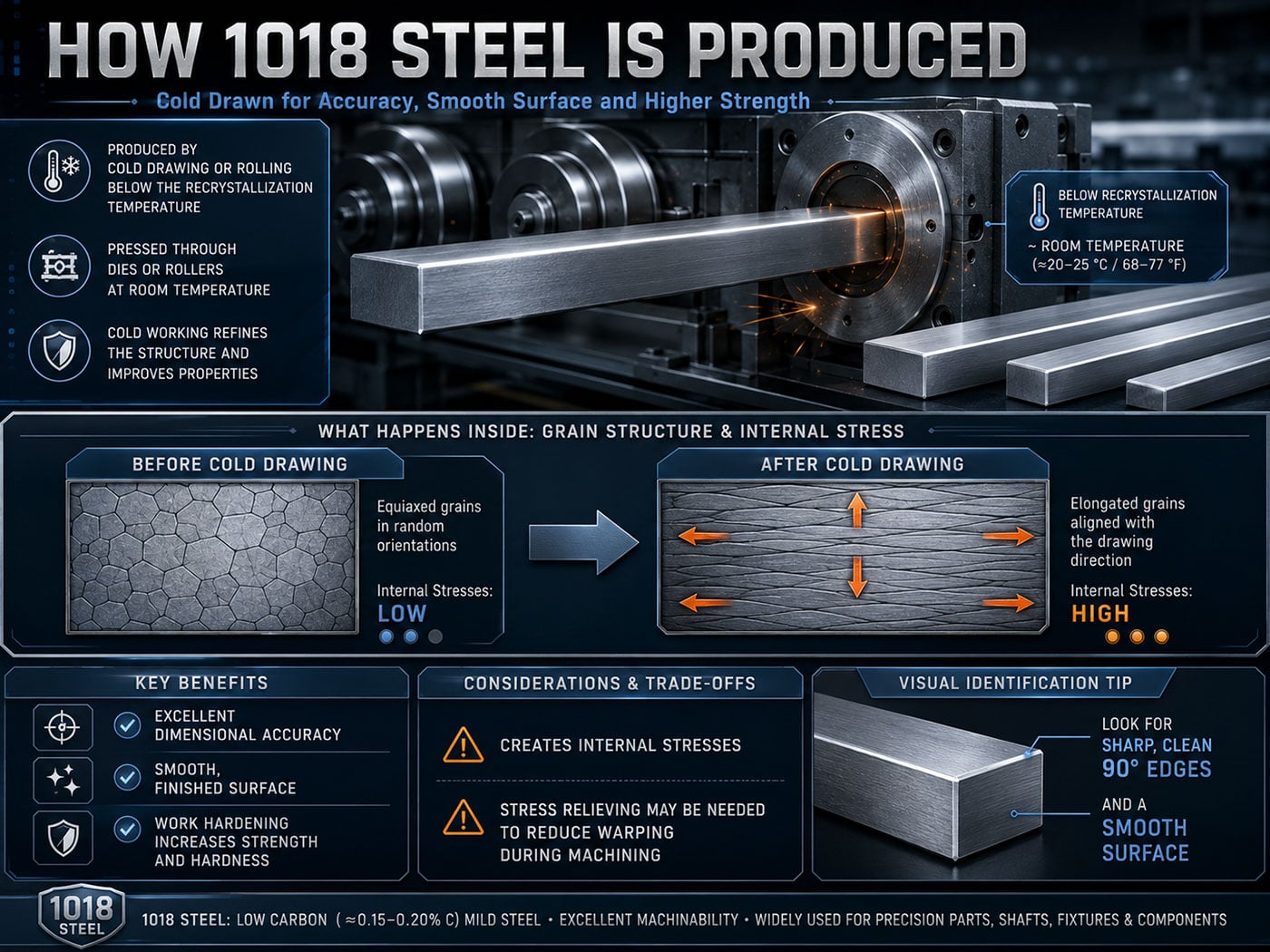
In this process, the metal is pressed through dies or rollers at room temperature to achieve excellent dimensional accuracy and a smooth surface.
However, whilst this work hardening significantly increases the strength and hardness of the steel, it also creates internal stresses that may require stress relieving to prevent warping during subsequent machining.
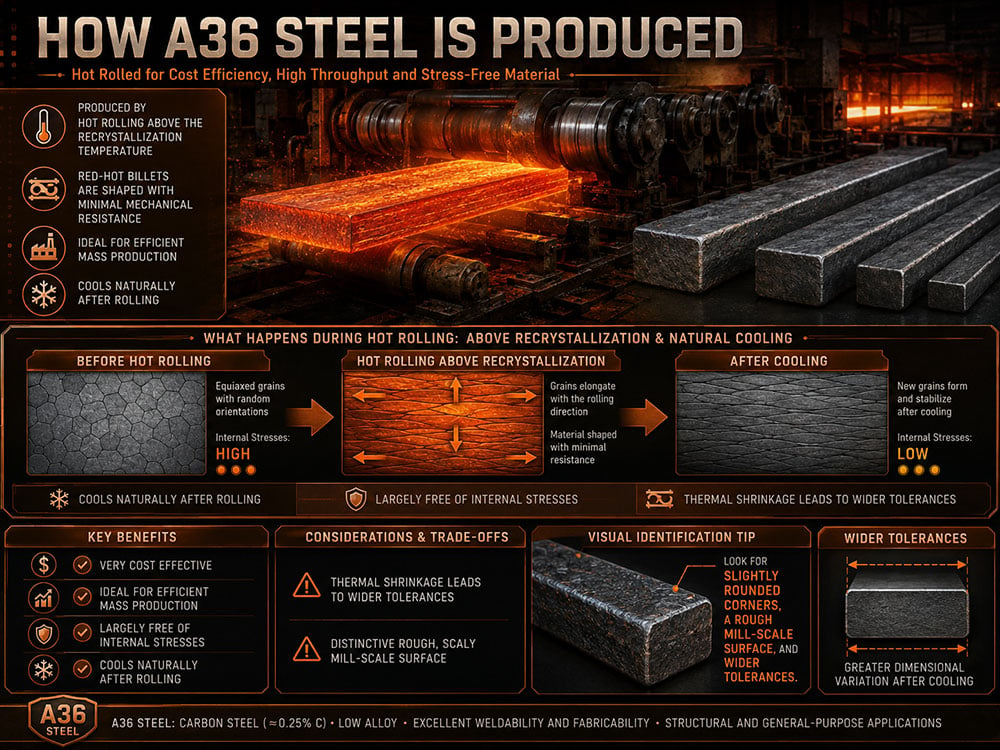
This process enables mass production, as red hot billets are shaped into their final form with minimal mechanical resistance.
The steel cools naturally, leaving it free of internal stresses and making it extremely cost effective; however, the thermal shrinkage that occurs during this process results in wider tolerances and a distinctive rough, scaly surface texture.
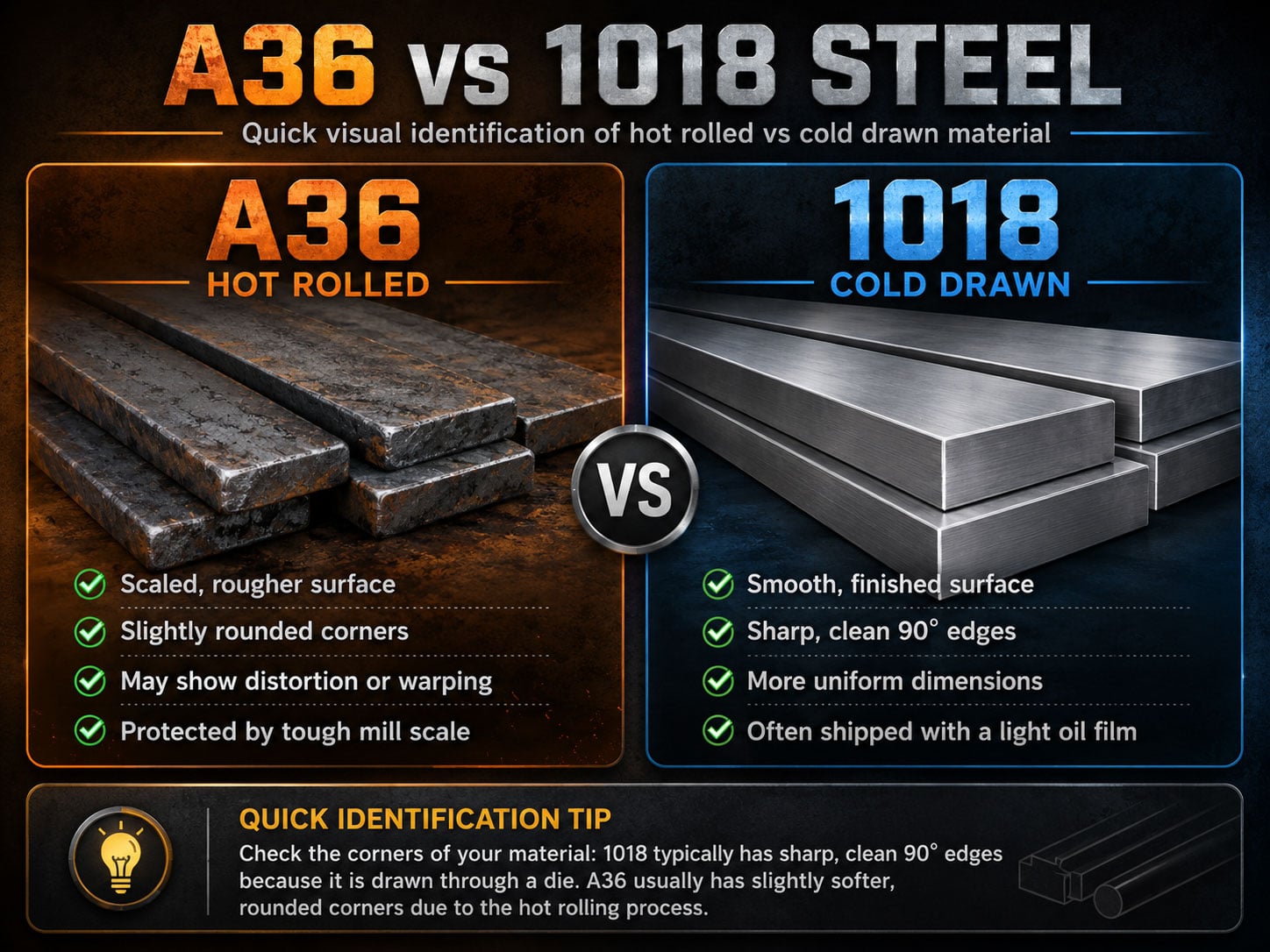
Comparison of Hot Finish vs Cold Finish
1018 vs. A36: When to Trade Precision for Structural Power
This comparison clarifies the choice between dimensional accuracy and raw structural utility:
1018 is like a machinist’s rod: The material is precise, uniform and designed for accuracy at high speeds. As the cold worked material has a dense, smooth surface with incredibly tight tolerances, it can be machined, slotted and case-hardened on a lathe without losing its geometry. This makes the material the first choice for mechanical parts that need to fit together perfectly, even if you have to pay a little extra for this ‘ready to use’ finish.
A36 is like a builder’s beam: It is robust, cost effective and designed as a load bearing element for large scale projects. As it is produced in the red-hot state, it has a resilient molecular structure, making it the gold standard for high performance welding work and the construction of structural frameworks. However, due to this heat treatment, it has a rough scale layer and less precise dimensions; it is designed more as a stable support than as a high precision component.
| Feature | 1018 (The "Precise" one) | A36 (The "Structural" one) |
|---|---|---|
| Dimensional Accuracy | Superior. Cold drawing ensures diameters and thickness are accurate to within +/-0.002” to 0.005” depending on bar size. | Low. Not intended for through-hardening and is generally used in the as-rolled state. |
| Surface Quality | Smooth and shiny. With a polished surface that is often suitable for electroplating or painting straight away. | Rough and scaly. Coated with dark mill scale, which usually needs to be ground off before welding. |
| Hardening Ability | High (Case only). Perfect for carburizing to create a hard outer case with a shock absorbing core. | Low. Generally used in its as rolled state; not intended for precision heat treatment. |
| Machinability | High. Chips break away cleanly, which leads to faster production cycles and longer tool life. | Moderate. A variable grain structure can lead to clumping during processing or uneven tool wear. |
| Total Cost of Ownership | Higher Material Cost. By reducing the amount of work and the time spent on post processing, it is possible to save costs. | Lower Machining Cost. The most economical choice for high volume structural projects. |
Decision Checklist: Which material should you order?
Yes: Choose 1018 (cold formed).
2. Are you building a large, heavy duty frame that requires a lot of welding?
Yes: Choose A36 (hot rolled).
3. Does the part need to have a “showroom ready” chrome or paint finish?
Yes: Choose 1018 (the smooth surface requires significantly less pre-treatment).
4. Is budget the most important factor for a concealed structural bracket?
Yes: Choose A36 (it is significantly more cost effective).
5. Do you need to case harden the surface for wear resistance?
Yes: Choose 1018 (its chemical composition is optimized for carburizing).
Weldability of Mild Steels: 1018 vs. A36 Compared
| Criteria | AISI 1018 | AISI A36 |
|---|---|---|
| Preferred for welding? | Yes; excellent for small to medium precision assemblies. | Yes; the industry standard for structural welding. |
| Key precautions | Watch for warping in thin sections due to relieved internal stresses. | Mandatory descaling; to avoid porosity in the weld, the mill scale must be ground off. |
| Filler choice | Filler should match the tensile strength of the base material. | Filler should match the tensile strength of the base material. |
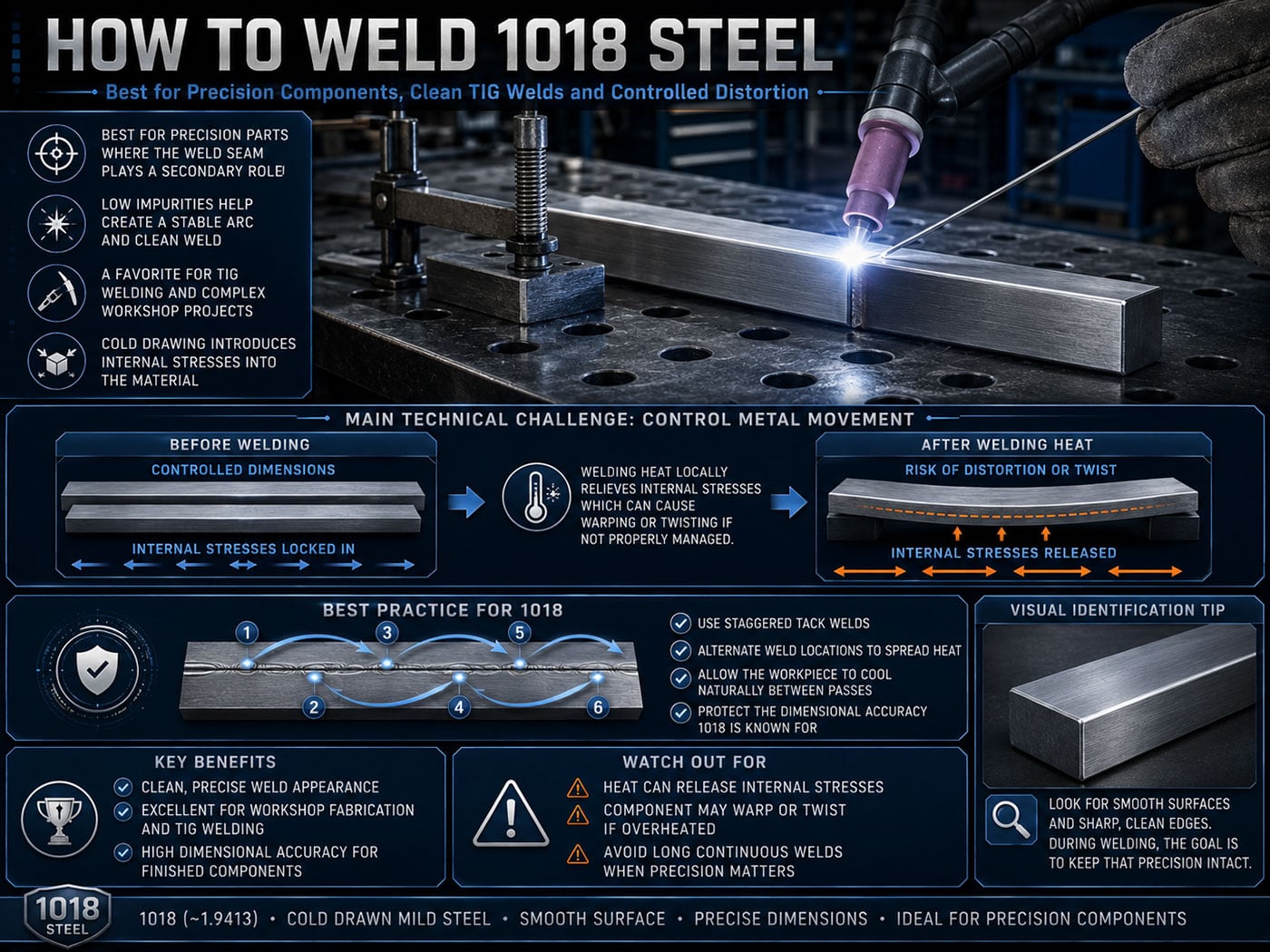
The primary technical objective with 1018 is to control the “movement” of the metal. Since cold rolling introduces energy into the grain structure, the heat from welding can act like a local annealing treatment, causing the component to warp or twist as these internal stresses are released. By using staggered tack welds and allowing the workpiece to cool naturally between weld passes, you can maintain the high dimensional accuracy for which this grade is known.
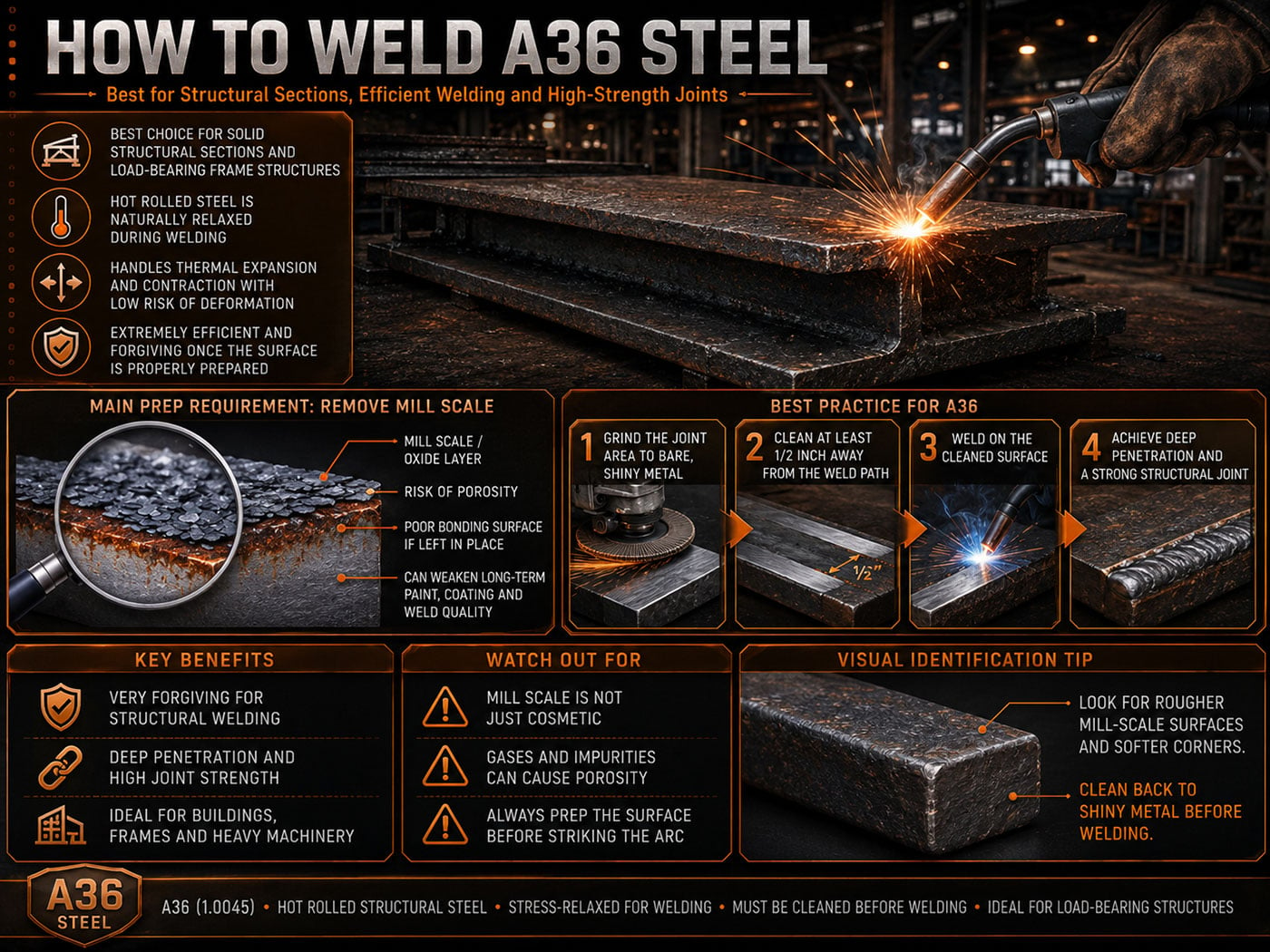
It is a layer of oxide in which gases and impurities can accumulate, potentially leading to “porosity” (tiny holes in the weld) or a brittle joint.
To achieve the best long term results, you should always grind the joint area down to bare, shiny metal extending at least 1/2 inch away from the weld path before striking the arc.
After cleaning, A36 becomes incredibly forgiving, allowing for deep penetration and high strength joints capable of easily supporting the weight of buildings or heavy machinery.
Conclusion
While 1018 (~1.9413) offers the tight tolerances and smooth surface finish required for high speed mechanical components and case hardening, A36 (~1.0045) remains the unmatched workhorse for heavy duty welding and large scale machinery manufacturing.
Ultimately, understanding the trade off between the refined consistency of 1018 and the versatile, stress free nature of A36 ensures that your material selection perfectly meets both your budget and your technical requirements.
Frequently Asked Questions: 1018 vs. A36 Tool Steel
A36 can be machined, but it is not recommended for high precision work. As A36 is hot rolled, it often contains “hard spots” and has an uneven grain structure, which can lead to unpredictable tool wear and a rougher surface finish. For components that require tight tolerances (within 0.002") and a polished finish, 1018 is a better choice.
2. Is A36 "stronger" than 1018 because it is used in buildings?
Not necessarily. A36 is preferred in construction because it has a guaranteed minimum yield strength (36,000 psi), which allows for reliable structural safety calculations. However, due to the work hardening that 1018 undergoes during the cold drawing process, this steel actually has a higher typical yield strength (~54,000 psi).
3. Do I need to remove the "black skin" on A36 before welding?
The short answer is yes. This “black layer” is mill scale (iron oxide). If you weld directly over this layer, the mill scale can trap gases and contaminants in the weld pool, leading to porosity and a significantly weaker joint. For best results, always grind the weld area down until you reach bare, shiny metal.
4. Which grade is better for outdoor use?
Neither type of steel is naturally corrosion-resistant. As both are low carbon “mild steels,” they rust quickly when exposed to moisture. That said, 1018 is often easier to coat (with zinc or chrome) or powder coat, as its smooth surface requires less pre-treatment than the pitted, scaly surface of A36.

Steel Expert • International Business • Digital Strategy
Since 2011, Patrice Gilliland has been actively shaping the international steel market as part of ABRAMS Industries®. She plays a key role in market development in the EU, the UK, and the US, as well as in the digital transformation of sales channels.