
 (331) 234-9900


 Sign In
 304 vs. 316 Steel - Beyond the Surface: When to Upgrade from Standard 304 to Marine Grade 316


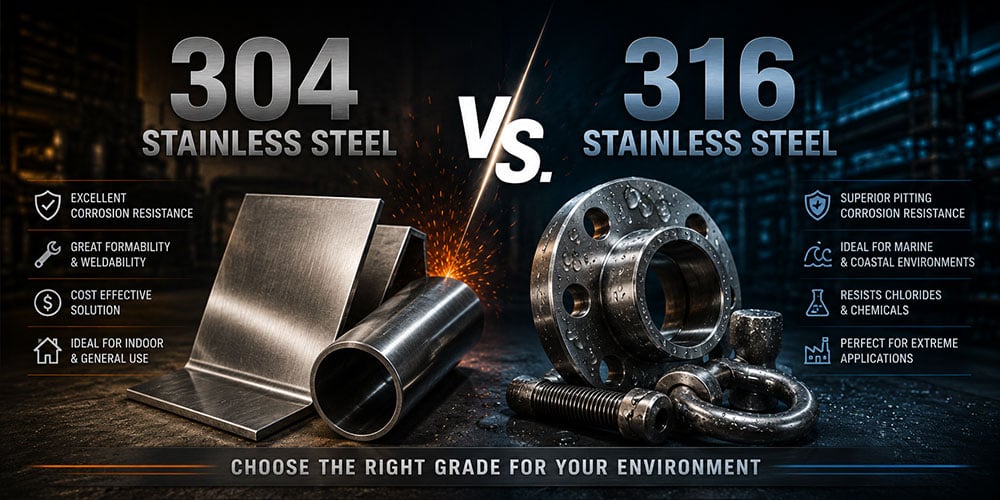
304 vs. 316 Steel - When selecting the right material for a project, it often comes down to a critical comparison between the two most common types of austenitic stainless steel. Examining the structural differences between these alloys allows us to determine which metal offers the best balance of durability and cost effectiveness for your specific requirements.
Table of Contents
- Chemical composition 304 vs. 316
- Summary of effects of alloying elements
- Typical application scenarios
- The Quick Guide to choosing the right grade
- What applications can each steel grade be used for?
- What are the similarities and differences of AISI 304 and AISI 316?
- Considerations and Limitations of 304 and 316 tool steel
- Mechanical properties for 304 vs 316
- 304 vs. 316: When You Should Upgrade for Marine Protection
- Decision Checklist: Which material should you order?
- Weldability of the steel grades compared
- Conclusion
- Frequently Asked Questions
Chemical composition 304 vs. 316
| Alloying element | 304 ( X5CrNi18-10 ) | 316 ( X5CrNiMo17-12-2 ) | Effect |
|---|---|---|---|
| Carbon (C) | 0 - 0.07% | 0 - 0.07% | Hardness vs Toughness |
| Silicon (Si) | 0 - 1% | 0 - 1% | Oxidation vs. Flow |
| Manganese (Mn) | 0 - 2% | 0 - 2% | Deoxidation & Strength |
| Phosphorus (P) | 0 - 0.045% | 0 - 0.045% | Maintained for structural purity |
| Sulfur (S) | 0 - 0.015% | 0 - 0.015% | |
| Chromium (Cr) | 17.5 - 19.5% | 16.5 - 18.5% | Corrosion vs. Wear |
| Nickel (Ni) | 8 - 10.5% | 10 - 13% | Ensures Ductility and Stability |
| Molybdenum (Mo) | 0 - 0.11% | 2 - 2.5% | Strength vs. Pitting |
Summary of effects of alloying elements
Stainless Steel 316: This grade is characterized by the addition of molybdenum, which specifically counteracts “pitting corrosion” caused by salt and industrial chemicals. By increasing the nickel content in combination with molybdenum, the steel achieves superior structural stability and significantly higher corrosion resistance in environments with high chloride content, making it the industry standard for marine engineering and chemical processing.
Typical application scenarios
| Scenario | Recommended Grade | Why |
|---|---|---|
| Indoor Commercial Kitchen | 304 | Without requiring unnecessary additives, this grade provides the necessary protection against moisture and organic acids in accordance with food safety standards, thanks to its high chromium and nickel content. |
| Marine Hardware & Boat Fittings | 316 | It is essential to add molybdenum to prevent “tea stains” and pitting corrosion caused by constant contact with saltwater and sea spray. |
| Residential Appliances | 304 | Offers the perfect balance between the aesthetic appeal of a “stainless steel” finish and durability for refrigerators and dishwashers where exposure to chemicals is minimal. |
| Pharmaceutical Processing | 316 | Its excellent resistance to aggressive chemical cleaning agents and sterilization processes with high chloride content ensures contamination free use and a longer service life for the equipment. |
| Coastal Architectural Facades | 316 | Protects buildings located within a 5 mile radius of the ocean, where salty air would corrode standard 304 stainless steel, from structural damage and surface rust. |
| Brewery and Dairy Vats | 304 | Due to its excellent weldability, it is possible to create smooth, hygienic seams that resist bacterial buildup in typical beverage industry production environments. |
The Quick Guide to choosing the right grade
Select 316 when designing facilities for coastal areas, chemical processing plants, or marine equipment where the metal is constantly exposed to chlorides and salt spray. The addition of molybdenum makes this grade indispensable for all applications where pitting or localized corrosion would, over time, compromise the structural integrity or hygiene of the component.
What applications can each steel grade be used for?
| Typical application | 304 | 316 |
|---|---|---|
| Kitchenware | Professional cookware and sinks | High end outdoor grills and coastal BBQ sets |
| Medical | Hospital beds and surgical trays | Orthopedic implants and chemical sterilizers |
| Fasteners | Standard nuts, bolts, and washers | Marine grade rigging and coastal anchors |
| Industrial | Brewing vats and dairy equipment | Pharmaceutical tanks and chemical mixers |
| Food Processing | Beverage piping and storage silos | Salt heavy food prep (e.g., brine or soy sauce) |
| Architecture | Interior elevator panels and handrails | Exterior facades for buildings near the ocean |
| Automotive | Exhaust systems and decorative trim | Fuel lines and heavy-duty marine engine parts |
| Tools | Measuring instruments and spatulas | Precision lab tools and saltwater submerged gear |
| Marine | Freshwater dock fittings and pontoons | Saltwater hulls, propellers, and underwater parts |
| Appliances | Dishwasher liners and washing drums | High performance industrial cleaning machines |
What are the similarities and differences of AISI 304 and AISI 316?
• 304: An extremely versatile austenitic stainless steel that, thanks to a balanced ratio of chromium and nickel, offers a ductile, easily weldable structure. It is the top choice for commercial kitchens, architectural interiors, and deep drawn components where general corrosion resistance and impact toughness are required in a cost effective package.
• 316: This high quality “marine grade” stainless steel, valued for its 2% molybdenum content, which significantly increases its resistance to salt spray and industrial solvents. The material was specifically developed for applications requiring long term structural integrity in coastal areas, pharmaceutical laboratories, and chemical processing plants, where standard alloys would ultimately succumb to pitting corrosion.
Considerations and Limitations of 304 and 316 stainless steel
• 304: This steel is the top choice for high quality corrosion resistance and structural reliability in general purpose applications, offering excellent weldability and a shiny, attractive finish. However, its main limitation is its susceptibility to ‘pitting’ in the presence of chlorides; therefore, its use should be avoided for marine equipment, coastal architecture, or environments with heavy industrial pollution, as salt and aggressive chemicals will corrode through the protective oxide layer over time and cause localized corrosion.
• 316: This grade is characterized by exceptional resistance to salt spray and aggressive industrial solvents, making it the essential “marine grade” solution for high risk applications. Although it is ideal for pharmaceutical and maritime applications, its higher nickel and molybdenum content does make it more expensive than 304, which can impact the budget of large scale projects. Furthermore, while it shares the same non magnetic properties as 304, it is slightly more difficult to machine, requiring your manufacturing team to account for the increased work hardening rate throughout the manufacturing process.
Mechanical properties for 304 vs 316 Steel
| Properties | 304 | 316 |
|---|---|---|
| Tensile strength | 100.0 KSI | 100.0 KSI |
| Working hardness | 195 - 215 BHN (on delivery) | approx. 215 BHN (on delivery) |
| Allowable working temperature | 68 - 392°F (20 - 200°C) | 68 - 1022 °F (20 - 550°C) |
| Machinability | two of six ⭐️⭐️★★★★ | two of six ⭐️⭐️★★★★ |
| Toughness | six of six ⭐️⭐️⭐️⭐️⭐️⭐️ | two of six ⭐️⭐️★★★★ |
| Wear resistance | one of six ⭐️★★★★★ | two of six ⭐️⭐️★★★★ |
| Corrosion resistance | six of six ⭐️⭐️⭐️⭐️⭐️⭐️ | six of six ⭐️⭐️⭐️⭐️⭐️⭐️ |
304 vs. 316: When You Should Upgrade for Marine Protection
This comparison highlights the difference between standard chemical resilience and extreme environmental endurance:
• Stainless steel 316 is like a guardian of the coast: It offers a level of corrosion resistance that is essential for the harshest environments worldwide. The addition of molybdenum gives the steel special protection against “pitting”, the microscopic holes that salty air and seawater corrode into conventional stainless steel. While it offers the same excellent weldability and strength as 304, this chemical enhancement ensures that the material remains flawless even when submerged in saltwater or used in aggressive pharmaceutical processes.
| Feature | 304 (The "Workhorse") | 316 (The "Guardian") |
|---|---|---|
| Pitting resistance | Moderate. It is ideal for indoor use, but may develop “tea stains” or small holes when exposed to salty air. | Superior. The addition of molybdenum creates a chemical protective barrieragainst chloride and brine. |
| Chemical Tolerance | Reliable. In controlled environments, it is resistant to most organic acids and food-grade disinfectants.. | Extreme. Designed specifically for use in environments with corrosive industrial acids and sea salt spray. |
| Upfront Investment | Lower. Offers the best value for money in general construction and kitchen construction. | Higher. Due to the higher nickel and molybdenum content, a higher market price is being charged. |
| Total Cost of Ownership | Lower for dry indoor areas that do not require special environmental protection. | Lower for components exposed to the elements or chemicals, as this helps avoid high replacement costs due to rust. |
Decision Checklist: Which material should you order?
Yes: Choose 304 (it provides the most cost effective balance of corrosion resistance and strength for inland use).
2. Will the part be exposed to heavy industrial chemicals, de-icing salt, or marine spray?
Yes: Choose 316 (with added molybdenum pitting and structural decay can be prevented).
3. Is the primary goal to achieve a food grade finish for a standard commercial kitchen or brewery?
Yes: Choose 304 (this steel grade is the global standard for sanitary food processing and remains non magnetic).
4. Are you designing pharmaceutical equipment or medical implants that require aggressive sterilisation?
Yes: Choose 316 (its superior chemical stability ensures it can withstand high concentration cleaning agents without surface breakdown).
5. Is budget the most important factor for a large scale, indoor architectural project?
Yes: Choose 304 (you get the same “stainless” aesthetic and high durability at a significantly lower cost).
6. Do you need maximum resistance to “tea staining” on an outdoor facade or coastal railing?
Yes: Choose 316 (the higher nickel and molybdenum content keep the surface looking pristine even in salt heavy air).
Weldability of the steel grades compared
| Criteria | 304 | 316 |
|---|---|---|
| Preferred for welding? | Yes; it is the global standard for general welded stainless structures | Yes; essential for welded components in marine or chemical environments. |
| Key precautions | Manage heat input to prevent weld decay and maintains surface hygiene. | Ensure the filler metal matches the molybdenum content of the base material to prevent pitting at the seam. |
| Filler choice | Standard chromium nickel filler to maintain the structural ductility and prevent rust. | Specialized molybdenum bearing fillers to preserve the defense against saltwater and acid pitting. |
If extensive welding or thermal joining is required, 304 is the superior all around candidate due to its natural ductility and high resistance to cracking during the cooling phase.
For 316, while it is equally weldable, the professional standard is to prioritize the use of low carbon "L" grade fillers and post weld surface restoration to ensure the joint retains the same salt resistance as the surrounding marine grade plate.
Conclusion
If your primary goal is high quality manufacturing for indoor spaces, freshwater environments, or standard commercial settings, you should choose AISI 304. Thanks to its excellent formability and weldability, this material enables cost effective production of everything from kitchen appliances to structural frameworks, provided the final product will not be exposed to strong salts or aggressive industrial chemicals.
If the long term integrity of the component is essential in harsh environments, you should opt for AISI 316. Whether your project involves coastal architecture, marine equipment, or pharmaceutical processing, the exceptional “pitting resistance” of 316 ensures a flawless, rust free service life. Although the material costs are higher, the protection against chloride induced corrosion damage justifies the investment, as it prevents premature failures and costly replacements.
If you understand the properties of these two proven metals, the versatile, high quality 304 compared to the robust, seawater resistant 316, you can optimize both your project’s budget and its long term reliability in service.
Frequently Asked Questions: 304 vs. 316 Stainless Steel
Both AISI 304 and AISI 316 are austenitic stainless steels that are inherently non magnetic in the annealed condition. However, it should be noted that both grades can become slightly magnetic after cold working, such as bending or deep drawing, or after welding. For applications where no magnetic interference is permitted, 316 generally exhibits lower magnetic permeability than 304 after processing.
2. Can I use 304 stainless steel for an outdoor project?
Yes, but the location is the key factor. 304 stainless steel is excellent for outdoor use in many inland areas. However, if the project is located within 5 miles of the coast or near a swimming pool, 304 stainless steel is likely to develop “tea stains” (surface rust). In areas with high chloride levels, it is strongly recommended to switch to 316 stainless steel to ensure a rust free surface.
3. Why is 316 stainless steel more expensive than 304?
The price difference primarily results from the chemical composition. AISI 316 contains molybdenum (typically 2 - 2.5%) and a higher percentage of nickel. Although the procurement and refinement of these alloying elements are more expensive, they are precisely what gives AISI 316 its superior resistance to pitting corrosion and chemical attacks compared to the standard alloy AISI 304.
4. Can 304 and 316 stainless steel be used in high temperature applications?
Yes, both materials are characterized by excellent oxidation resistance, but they behave differently under extreme heat. Material 304 is generally suitable for temporary use at temperatures up to 1600 °F (870°C). However, for projects involving continuous exposure to high temperatures or requiring higher “creep resistance” (resistance to deformation under constant stress at high temperatures), Grade 316 is the better choice. Thanks to its more robust alloy composition, it maintains its structural integrity and corrosion resistance in thermal environments where standard 304 might be prone to scaling or weakening.

Steel Expert • International Business • Digital Strategy
Since 2011, Patrice Gilliland has been actively shaping the international steel market as part of ABRAMS Industries®. She plays a key role in market development in the EU, the UK, and the US, as well as in the digital transformation of sales channels.