
 (331) 234-9900


 Sign In
 A2 vs. O1 Tool Steel: Stability vs. Sharpness


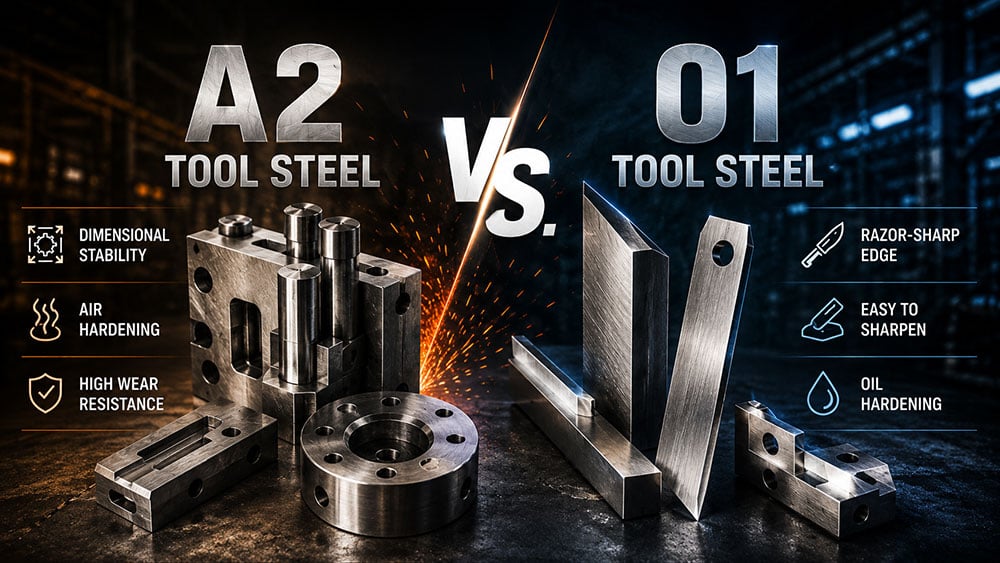
Table of Contents
- Chemical composition A2 vs. O1
- Summary of effects of alloying elements
- Typical application scenarios
- The Quick Guide to choosing the right grade
- What applications can each steel grade be used for?
- What are the similarities and differences of AISI A2 and AISI O1?
- Considerations and Limitations of A2 and O1 tool steel
- Mechanical properties for A2 vs O1
- A2 vs. O1: When you should trade toughness for stability to reduce part costs
- Decision Checklist: Which material should you order?
- Weldability of the steel grades compared
- Conclusion
- Frequently Asked Questions
Chemical composition A2 vs. O1 Steel
| Alloying element | A2 ( X100CrMoV5 ) | O1 (90MnCrV8) | Effect |
|---|---|---|---|
| Carbon (C) | 0.95 - 1.05% | 0.9 - 1.05% | Toughness & Stability vs. Hardness & Edge Retention |
| Silicon (Si) | 0.1 - 0.4% | 0.15 - 0.35% | Strength & Deoxidation |
| Manganese (Mn) | 0.4 - 0.8% | 1 - 1.2% | Hardenability, Stability & Deoxidation |
| Phosphorus (P) | 0 - 0.03% | 0 - 0.035% | Impurity Control |
| Sulfur (S) | 0 - 0.03% | 0 - 0.035% | Machinability vs. Structural Integrity |
| Chromium (Cr) | 4.8 - 5.5% | 0.5 - 0.7% | Hardenability & Wear Resistance |
| Molybdenum | 0.9 - 1.2% | - | Deep Hardening & Strength at Temperature |
| Vanadium | 0.15 - 0.35% | 0.05 - 0.15% | Fine Grain Structure & Sharpness |
| Tungsten | - | 0.5 - 0.7% | Red Hardness & Abrasion Resistance |
Summary of effects of alloying elements
Molybdenum in A2: The inclusion of Molybdenum is what allows A2 to be "Air Hardening", which means it cools more slowly and is far less likely to crack or warp than O1.
O1's Manganese & Tungsten: O1 relies on Manganese and a touch of Tungsten to achieve its hardness. This combination allows it to be quenched in oil at lower temperatures, resulting in a keen, razor sharp edge that is easier to sharpen than A2.
Typical application scenarios
| Scenario | Recommended Grade | Why |
|---|---|---|
| Large Blanking Dies | A2 | Superior dimensional stability; the air hardening process prevents warping or cracking in large, complex cross sections. |
| Custom Hand Tools & Knives | O1 | Can be quenched to a finer, keener edge and is much easier to sharpen using traditional stones. |
| High-Precision Gauges | A2 | Excellent resistance to "growing" or shrinking over time; maintains its precise measurements after heat treatment. |
| Intricate Stamping Punches | O1 | High machinability in its annealed state allows for very detailed EDM or manual filing work before hardening. |
| Heavy Duty Industrial Shears | A2 | Higher Chromium and Molybdenum content provide the abrasive wear resistance needed for long production runs |
| Small Drill Bushings | O1 | An economical choice for small parts where deep hardening is easily achieved in an oil bath. |
The Quick Guide to choosing the right grade
Choose O1(1.2510) if you are working on a smaller scale, require a razor sharp cutting edge, or prefer a steel that is easier to machine and grind with standard workshop equipment.
What applications can each steel grade be used for?
| Typical application | A2 | O1 |
|---|---|---|
| Dies | Blanking and forming dies | Short run trim dies |
| Punches | Heavy duty punches | Small diameter punches |
| Gauges | Master and precision gauges | General shop gauges |
| Knives | Industrial granulator knives | Handheld woodturning tools |
| Rollers | High pressure thread rollers | Light duty forming rolls |
| Shears | Metal slitting blades | Paper and fabric shears |
| Stamping | Progressive stamping dies | Simple Stamp sets |
| Molds | Plastic injection molds | Prototype molding |
| Drills | High wear masonry bits | Special twist drills |
What are the similarities and differences of O1 and A8 Steel?
• AISI A2: A versatile air hardening steel that utilizes a 5% chromium content to minimize movement and warping during the hardening process. It is the preferred choice for complex tooling and high volume production where superior abrasive wear resistance and stability are non-negotiable.
• AISI O1: A classic oil hardening steel prized for its refined grain structure and excellent machinability. It is specifically engineered for applications that require a razor sharp cutting edge and the convenience of being heat treated with standard oil quench equipment.
Considerations and Limitations of A2 andO1 tool steels
When selecting between these grades, your choice depends on whether the heat treatment safety or the edge refinement is the bigger priority. While both are staples of the tool room, their specific alloying elements impose strict limits on the size of the parts you can produce and the level of impact they can withstand.
• A2 Steel: This grade is the premier choice for reducing the risk of distortion and cracking in large or complex sections, but its high chromium content makes it significantly more difficult to grind and sharpen than low alloy steels. It should be avoided for extremely fine edged cutting tools where a razor finish is required, as the relatively coarse carbides can lead to microscopic chipping under delicate loads.
• O1 Steel: This material is characterized an exceptional ability to take a keen, high honed edge, excellent machinability and is generally easy to machine; however, since it must be quenched in oil, it is highly susceptible to deformation or quenching cracks in components with thin walls or significant variations in wall thickness.
Mechanical properties for A2 vs O1 Steel
| Properties | A2 | O1 | |
|---|---|---|---|
| Tensile strength | 118.2 KSI | 111.6 KSI | |
| Working hardness | 58 - 62 HRC | 57 - 62 HRC | |
| Allowable working temperature | 68 - 392°F 20 - 200°C | 68 - 392 °F 20 - 200°C | |
| Machinability | three of six ⭐️⭐️⭐️★★★ | four of six ⭐️⭐️⭐️⭐️★★ | |
| Toughness | two of six ⭐️⭐️⭐️★★★ | three of six ⭐️⭐️⭐️★★★ | |
| Wear resistance | four of six ⭐️⭐️⭐️⭐️★★ | four of six ⭐️⭐️⭐️⭐️★★ | |
| Corrosion resistance | three of six ⭐️⭐️⭐️★★★ | two of six ⭐️⭐️★★★★ |
A2 vs. O1: When you should trade toughness for stability to reduce part costs
A2 is like seasoned oak: It is incredibly stable and dependable. Because it hardens in still air, it doesn't "shock" during cooling, meaning it holds its exact dimensions without warping or cracking. This makes it the "safe" choice for large, complex industrial parts, but it is much more stubborn to grind or sharpen once it is hard.
O1 is like a fine crystal: It is capable of achieving a level of sharpness and polish that is nearly unmatched. When you sharpen it, the grain structure allows for a microscopic, razor like edge. However, that same internal "delicacy" means that if you quench a complex shape in oil, the thermal shock can cause the material to warp or even snap if the design has thin walls.
| Feature | A2 (The “Stable” one) | O1 (The “Sharp” one) |
|---|---|---|
| Heat Treatment Risk | Very Low. Air cooling prevents the "quench shock" that causes cracking and warping. | Moderate. Oil quenching is aggressive; complex or thin parts may distort or crack |
| Edge Keenness | Good. Holds a working edge for a long time, but lacks "razor" refinement. | Excellent. The gold standard for tools requiring a surgical or wood-shaving edge. |
| Wear Resistance | High. Added Chromium and Molybdenum allow it to survive millions of cycles. | Moderate. Excellent for shorter runs, but wears faster than A2 in high friction use. |
| Total Cost of Ownership | Lower long-term cost for high volume parts due to durability and stability. | Lower upfront cost for custom tools due to easier machining and grinding. |
Decision Checklist: Which material should you order?
Yes: Choose A2 (its 5% Chromium "Air Hardening" chemistry ensures maximum dimensional stability and prevents the warping or cracking often caused by liquid quenching).
2. Do you need to achieve a surgical, razor sharp edge for fine woodworking or intricate cutting tools?
Yes: Choose O1 (the refined grain structure and Manganese-Tungsten alloy allow for a microscopic, high honed edge that is far easier to sharpen than high chromium steels).
3. Is the component subject to heavy abrasive wear in a high volume industrial production environment?
Yes: Choose A2 (the addition of Molybdenum and higher Chromium provides superior resistance to surface erosion, extending the life of the tool over millions of cycles).
4. Are you working in a basic shop environment without specialized high temperature atmospheric furnaces?
Yes: Choose O1 (it is the most "forgiving" tool steel for manual heat treating, requiring lower hardening temperatures and a simple oil quench to reach full functional hardness).
5. Does the part feature dramatic changes in thickness or very thin walls that might "shock" during cooling?
Yes: Choose A2 (because it cools slowly in still air, the internal thermal stresses are minimized, protecting delicate geometries from shattering during the transformation).
6. Is the primary goal to minimize upfront fabrication costs on a short run or prototype tool?
Yes: Choose O1 (it offers excellent machinability and grindability in its annealed state, allowing for faster metal removal and reduced tooling costs during the build phase).
Weldability of the steel grades compared
| Criteria | A2 | O1 |
|---|---|---|
| Preferred for welding? | No; extremely high risk of cracking without strict controls. | No; sensitive to thermal shock and localized hardening. |
| Key precautions | Avoid structural loads; use low heat input | Avoid rapid cooling; use heat management to prevent localized brittle zones. (hydrogen embrittlement). |
| Filler choice | High ferrite / Dissimilar Fillers (designed to prevent cracking) | Low carbon stainless fillers (matching the base material) |
If your project requires high strength joining or structural integrity, welding should be avoided for both grades. These are deep-hardening steels, meaning the heat from a weld creates an extremely brittle zone (HAZ) that will likely snap under pressure. If a repair is absolutely necessary, AISI A2 is slightly more manageable because its air hardening nature allows it to handle the cooling cycle with less internal stress than O1.
For AISI O1, welding is exceptionally risky. The intense heat followed by rapid cooling, even in open air, can cause the area around the weld to reach maximum hardness and shatter instantly. For both steels, always consider mechanical joining alternatives, such as bolts, dowel pins, or precision fit threads, to maintain the integrity of the heat treated tool.
d stress, or consider mechanical joining alternatives if feasible.
Conclusion
Opt for A2 when you are producing large, complex dies or high volume industrial components that require maximum dimensional stability and superior resistance to abrasive wear.
Select O1 for smaller, intricate tools and custom blades where a razor sharp, fine grained edge and ease of machining are more critical than long term high impact endurance.
Whether you value the seasoned oaks reliability of air hardening A2 or the fine crystal precision of oil hardening O1, matching the grade to your specific quench capabilities and wear requirements is the key to a successful project.
Frequently Asked Questions: A2 vs. O1 Tool Steel
While both steels can achieve a hardness of 58 - 62 HRC, A2 has a higher chromium and molybdenum content, which generally gives it better long term wear resistance. O1 allows for a finer, “sharper” cutting edge, but may wear out more quickly than A2 in industrial environments with high levels of abrasion.
Can you air harden O1 tool steel?
No, AISI O1 is a low alloy steel requiring rapid quenching in oil to achieve its full hardness. An attempt to air harden O1 results in a soft pearlite structure that lacks the strength required for toolmaking. Unlike O1, AISI A2 is specifically designed for air hardening, which reduces the risk of distortion.
Which steel is easier to sharpen, A2 or O1?
O1 tool steel (1.2510) is significantly easier to sharpen and can be honed to razor sharpness. Since A2 (1.2363) contains large, wear resistant chromium carbides, it is much more difficult to grind. O1 (1.2510) is therefore often the preferred choice for hand tools such as chisels or planer blades, which require frequent sharpening.
Why is A2 better for large or complex dies?
Due to its air hardening properties, which ensure excellent dimensional stability, A2 is particularly favored for large tools. During the cooling process, air hardening steels are subjected to less thermal “shock” than oil hardened steels, thereby preventing cracks and deformations that could damage a complex tool during heat treatment.

Steel Expert • International Business • Digital Strategy
Since 2011, Patrice Gilliland has been actively shaping the international steel market as part of ABRAMS Industries®. She plays a key role in market development in the EU, the UK, and the US, as well as in the digital transformation of sales channels.