
 (331) 234-9900


 Sign In
 A2 vs A8 Tool Steel: Properties, Hardness and Applications Compared
06/16/2026


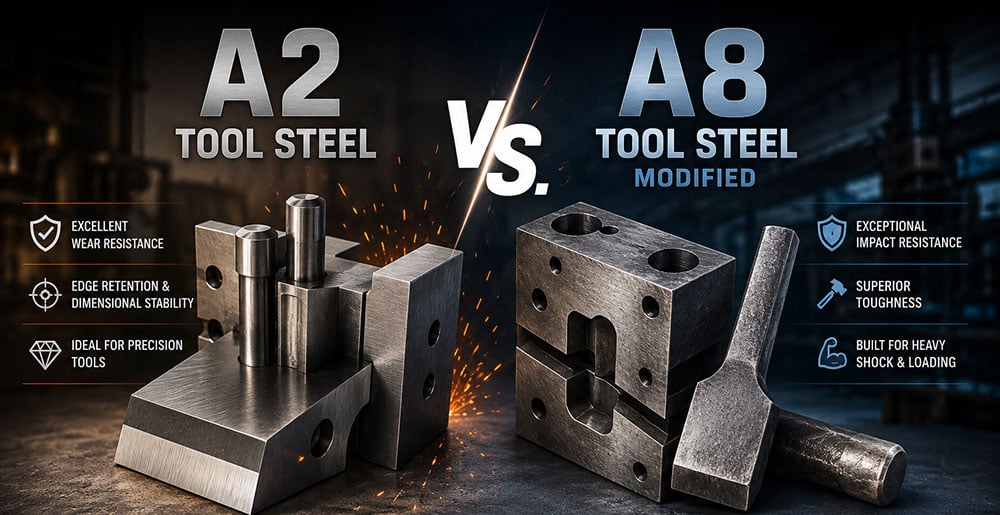
A2 steel offers an excellent balance of wear resistance and toughness. A8 mod. steel is engineered for exceptional impact resistance and toughness. A2 Steel and A8 Steel modified are known for their reliable performance and dimensional stability during heat treatment. Both are part of the AISI A-series of air-hardening steels.
Table of Contents
- Chemical composition A2 vs. A8 Steel
- Effects of carbon in A2 and A8 tool steel
- What is an air hardening steel?
- Direct comparison for typical application scenarios
- What applications can each steel grade be used for?
- What are the similarities and differences of A2 and A8 Steel?
- Considerations and Limitations of A2 and A8 mod. tool steels
- Comparison for A2 and A8 mod. of material properties
- Mechanical properties for A2 vs A8 Steel
- A2 vs. A8 modified steel: When you should trade hardness for toughness to avoid downtime
- Decision Checklist: Which material should you order?
- Weldability of the steel grades compared
- Comparative Analysis of Welding Filler Metals for A2 and A8 mod. Tool Steels
- Availability and costs
- Conclusion
A2 tool steel offers an excellent balance of wear resistance and toughness, making it a popular choice for precision tooling such as blanking dies, shear blades, and punches. Its ability to maintain sharp edges and resist deformation under stress makes it a go-to material for general-purpose tooling in high-production environments.
A8 mod. tool steel, on the other hand, is engineered for exceptional impact resistance and toughness, making it ideal for applications where tools are subjected to heavy shock and loading. It is widely used for forming dies, cold chisels, and other tools that demand superior resistance to cracking and breakage.
Whether you need the edge retention of A2 or the toughness of A8 mod., we offer both grades in various dimensions and forms - ready to meet your production needs with reliable, consistent quality.
A8 mod. tool steel, on the other hand, is engineered for exceptional impact resistance and toughness, making it ideal for applications where tools are subjected to heavy shock and loading. It is widely used for forming dies, cold chisels, and other tools that demand superior resistance to cracking and breakage.
Whether you need the edge retention of A2 or the toughness of A8 mod., we offer both grades in various dimensions and forms - ready to meet your production needs with reliable, consistent quality.
Chemical composition A2 vs. A8 Steel
| Alloying element | A2 ( X100CrMoV5 ) | A8 mod. ( ~ X48CrMoV8-1-1 ) | Effect |
|---|---|---|---|
| Carbon (C) | 0.95 - 1.05% | 0.45 - 0.5% | Hardness vs Toughness |
| Silicon (Si) | 0.1 - 0.4% | 0.7 - 0.9% | |
| Manganese (Mn) | 0.4 - 0.8% | 0.35 - 0.45% | Deoxidation & Strength |
| Phosphorus (P) | 0 - 0.03% | 0 - 0.02% | |
| Sulfur (S) | 0 - 0.03% | 0 - 0.005% | |
| Chromium (Cr) | 4.8 - 5.5% | 7.3 - 7.8% | Through-hardening & Corrosion protection |
| Molybdenum | 0.9 - 1.2% | 1.3 - 1.5% | Heat resistance & Toughness |
| Vanadium | 0.15 - 0.35% | 1.3 - 1.5% | Wear resistance (carbide former) |
Effects of carbon in A2 and A8 tool steel
A2: The high carbon content causes massive chromium and vanadium carbides to form. This makes the steel extremely resistant to abrasion, but more brittle when subjected to impact.
A8 modified: The significantly lower C content prevents the structure from becoming too brittle. The alloy is optimized for a stable matrix that absorbs energy on impact without breaking.
A8 modified: The significantly lower C content prevents the structure from becoming too brittle. The alloy is optimized for a stable matrix that absorbs energy on impact without breaking.
What is an air hardening steel?
Among our most trusted cold work tool steels are A2 and A8 mod., both part of the AISI A-series of air-hardening steels known for their reliable performance and dimensional stability during heat treatment.
Air-hardening steel is hardened by natural cooling or in controlled vacuum furnaces, with controlled environments allowing for more precise control of hardness and cooling speed.
However, since improper cooling can lead to cracks or fractures, the exact choice of cooling method and rate is critical to ensuring structural integrity and desired performance.
Air-hardening steel is hardened by natural cooling or in controlled vacuum furnaces, with controlled environments allowing for more precise control of hardness and cooling speed.
However, since improper cooling can lead to cracks or fractures, the exact choice of cooling method and rate is critical to ensuring structural integrity and desired performance.
Direct comparison for typical application scenarios
A2 vs. A8 mod. application scenarios:
| A2 | A8 mod. |
|---|---|
| Precision punches/dies from A2 retains sharp edges for an extremely long time (edge stability). It remains dimensionally stable. | Chisels/bending tools from A8 mod. require the ability to absorb heavy impacts without parts breaking off the cutting edge. |
| Thin cutting inserts from A2 are ideal for high friction and low mechanical impact loads. | Heavy forming tools from A8 mod. The higher ductility (formability before breaking) prevents total failure. |
To make the right choice, it helps to look at the load profile of your tool. Since both steels are air-hardening, the risk of distortion during heat treatment is low for both. The decisive difference lies in their reaction to mechanical stress.
What applications can each steel grade be used for?
Typical applications:
| A2 | A8 mod. |
|---|---|
| Blanking tools | Blanking tools |
| Stamping tools | Stamping tools |
| Dies | Embossing tools |
| Punches | Forming dies |
| Trimming tools | Press dies |
| Thread rolling dies | Die inserts |
| Thread rolling tools | Extrusion dies |
| Cold stamping tools | Reinforcements |
| Cold pilger mandrels | Cold extrusion tools |
| Circular shear knives | Tube tools |
| Cutting tools | Cutting tools |
| Shear knives | Industrial knives |
| Plastic molds | Wood chip knives |
| Wear inserts | Veneer knives |
What are the similarities and differences of A2 and A8 Steel?
Both are air-hardening cold work tool steels, they differ significantly in their metallurgical properties and performance priorities.
• A2 offers maximum wear resistance and dimensional stability for precision tools thanks to chromium and vanadium carbides.
• A8 modified, on the other hand, scores with extreme toughness and impact resistance under shock loads.
• A2 offers maximum wear resistance and dimensional stability for precision tools thanks to chromium and vanadium carbides.
• A8 modified, on the other hand, scores with extreme toughness and impact resistance under shock loads.
Considerations and Limitations of A2 and A8 mod. tool steels
• A2 offers high wear resistance but is susceptible to breakage when subjected to impact.
• A8 mod. scores highly in terms of toughness but wears out more quickly.
The choice therefore depends heavily on impact load and abrasion.
• A8 mod. scores highly in terms of toughness but wears out more quickly.
The choice therefore depends heavily on impact load and abrasion.
Comparison for A2 and A8 mod. of material properties
To better weigh the differences between the two tool steels, it helps to look at the key aspects:
• A2 (wear-resistant): Ideally suited for cutting and punching tools, however, requires precise heat treatment to avoid brittleness.
• A8 mod. (tough): Excellent for applications with high impact loads, but requires more frequent maintenance in cases of abrasive contact.
• A2 (wear-resistant): Ideally suited for cutting and punching tools, however, requires precise heat treatment to avoid brittleness.
• A8 mod. (tough): Excellent for applications with high impact loads, but requires more frequent maintenance in cases of abrasive contact.
Mechanical properties for A2 vs A8 Steel
| Properties | A2 | A8 mod. | |
|---|---|---|---|
| Tensile strength | 118.2 KSI | 123.2 KSI | |
| Working hardness | 58 - 62 HRC | 50 - 60 HRC | |
| Allowable working temperature | 68 - 392°F 20 - 200°C | 68 - 932°F 20 - 200°C | |
| Machinability | three of six ⭐️⭐️⭐️★★★ | three of six ⭐️⭐️⭐️★★★ | |
| Toughness | two of six ⭐️⭐️★★★★ | five of six ⭐️⭐️⭐️⭐️⭐️★ | |
| Wear resistance | four of six ⭐️⭐️⭐️⭐️★★ | five of six ⭐️⭐️⭐️⭐️⭐️★ | |
| Corrosion resistance | three of six ⭐️⭐️⭐️★★★ | three of six ⭐️⭐️⭐️★★★ |
1 star low, 6 stars high.
A2 vs. A8 modified steel: When you should trade hardness for toughness to avoid downtime
Imagine you are buying tool steel for a punch. You have a choice between two steel gardes: A2 and A8 mod. steel.
A clear comparison: glass vs. hardwood
This comparison helps to understand the difference in toughness:
• A2 is like extremely hard display glass: it is incredibly scratch-resistant and retains its shape forever – but if it falls hard on the floor or is hit by a stone, it shatters immediately (brittle fracture).
• A8 mod. is like high-quality hardwood: it is still very strong, but it has an inner elasticity. When struck, the material yields microscopically instead of tearing or splintering.
A clear comparison: glass vs. hardwood
This comparison helps to understand the difference in toughness:
• A2 is like extremely hard display glass: it is incredibly scratch-resistant and retains its shape forever – but if it falls hard on the floor or is hit by a stone, it shatters immediately (brittle fracture).
• A8 mod. is like high-quality hardwood: it is still very strong, but it has an inner elasticity. When struck, the material yields microscopically instead of tearing or splintering.
What does this mean for your calculation?
| Criteria | A2 (The “hard” one) | A8 mod. (The “tough” one) |
|---|---|---|
| Wear | Excellent. The tool stays sharp for a long time. | Good, but may need to be resharpened more often. |
| Risk of failure | High when subjected to impact. A small fault in the machine can lead to total failure (breakage). | Low. The tool can withstand overloads and impacts without breaking immediately. |
| Total cost of ownership (TCO) | Cheaper to purchase, but expensive in the event of unplanned production stoppages due to breakage. | Slightly more expensive or maintenance-intensive, but ensures stable production. |
Decision Checklist: Which material should you order?
1. Is the primary failure mode of your current tool "chipping," "cracking," or "shattering" under heavy loads?
Yes: Choose A8 mod. (its lower carbon content and specialized alloy design provide the extreme toughness and ductility needed to absorb sudden kinetic energy without structural failure).
2. Are you designing high-precision blanking dies or punches that must maintain a razor-sharp edge over millions of cycles?
Yes: Choose A2 (the high concentration of hard chromium and vanadium carbides creates a matrix that is exceptionally resistant to abrasive wear and edge degradation).
3. Does your application involve heavy-duty "cold work" like chiseling, heavy-gauge forming, or high-impact shearing?
Yes: Choose A8 mod. (this grade is specifically engineered to bridge the gap between high-speed steels and shock-resisting steels, offering a "safety net" against impact-induced breakage).
4. Is "dimensional stability" your top priority for a complex, multi-component tool assembly where tolerances are measured in microns?
Yes: Choose A2 (as a classic air hardening steel with 5% Chromium, it exhibits minimal volume change during heat treatment, ensuring that parts fit together perfectly after hardening).
5. Do you anticipate the need for design changes or repairs that might require welding during the tool’s lifecycle?
Yes: Choose A8 mod. (while all tool steels require care, A8 mod. is significantly more "forgiving" during welding due to its tougher microstructure, which is less prone to the immediate underbead cracking seen in higher carbon steels like A2).
6. Are you processing abrasive materials (like glass-filled plastics or high-silicon metals) that quickly "sand down" tool surfaces?
Yes: Choose A2 (the superior "red hardness" and carbide density allow the tool to resist surface erosion much longer than the tougher, but slightly softer, matrix of A8 mod.).
Yes: Choose A8 mod. (its lower carbon content and specialized alloy design provide the extreme toughness and ductility needed to absorb sudden kinetic energy without structural failure).
2. Are you designing high-precision blanking dies or punches that must maintain a razor-sharp edge over millions of cycles?
Yes: Choose A2 (the high concentration of hard chromium and vanadium carbides creates a matrix that is exceptionally resistant to abrasive wear and edge degradation).
3. Does your application involve heavy-duty "cold work" like chiseling, heavy-gauge forming, or high-impact shearing?
Yes: Choose A8 mod. (this grade is specifically engineered to bridge the gap between high-speed steels and shock-resisting steels, offering a "safety net" against impact-induced breakage).
4. Is "dimensional stability" your top priority for a complex, multi-component tool assembly where tolerances are measured in microns?
Yes: Choose A2 (as a classic air hardening steel with 5% Chromium, it exhibits minimal volume change during heat treatment, ensuring that parts fit together perfectly after hardening).
5. Do you anticipate the need for design changes or repairs that might require welding during the tool’s lifecycle?
Yes: Choose A8 mod. (while all tool steels require care, A8 mod. is significantly more "forgiving" during welding due to its tougher microstructure, which is less prone to the immediate underbead cracking seen in higher carbon steels like A2).
6. Are you processing abrasive materials (like glass-filled plastics or high-silicon metals) that quickly "sand down" tool surfaces?
Yes: Choose A2 (the superior "red hardness" and carbide density allow the tool to resist surface erosion much longer than the tougher, but slightly softer, matrix of A8 mod.).
Weldability of the steel grades compared
| Criteria | A2 | A8 mod. |
|---|---|---|
| Preferred for welding? | Only when necessary; needs precise control | More forgiving but still needs care |
| Key precautions | High preheat, post-weld tempering | Moderate preheat, stress relief advised |
| Filler choice | Tool steel or nickel alloy | Ductile filler or matching tool steel |
Best practice:
If welding is unavoidable, A8 Mod. is the better candidate due to its improved toughness and lower carbon content.
For A2, extreme care must be taken to control temperature and stress, or consider mechanical joining alternatives if feasible.
If welding is unavoidable, A8 Mod. is the better candidate due to its improved toughness and lower carbon content.
For A2, extreme care must be taken to control temperature and stress, or consider mechanical joining alternatives if feasible.
Comparative Analysis of Welding Filler Metals for A2 and A8 mod. Tool Steels
| Steel Grade | Filler | Purpose |
|---|---|---|
| A2 | Tool steel filler with matching hardness | For work surfaces |
| A2 | Nickel based alloy | For buffer layers to prevent cracks |
| A8 mod. | Tough Cr - Mo filler | Maintains impact toughness |
| A8 mod. | Similar alloy | Maximum homogeneity of the structure |
Availability and costs
Availability:
A2 tool steel is more commonly stocked and available in a broader range of forms and dimensions, including round bars, flat bars, sheets, plates, and precision ground stock. It’s a staple in many general-purpose tooling applications, which contributes to strong global demand and continuous production.
A8 tool steel is also readily available, though it is somewhat more niche compared to A2. It is typically offered in flat bar, plate, and block form, catering to tooling and forming applications where high toughness is essential. Lead times may be slightly longer for less common dimensions or highly customized grades.
Cost Factors:
The pricing of tool steels such as A2 and A8 depends on a variety of factors including alloy composition, demand, form availability, and processing requirements.
A2 tool steel is typically cost-effective due to its widespread use in general tooling and its availability in standard forms. Its balanced alloy content provides a good compromise between performance and affordability, making it a popular choice in many industries.
A8 tool steel, while still readily available, is generally positioned at a slightly higher price level. This reflects its more specialized role in applications requiring high shock resistance, as well as the tighter material specifications often associated with such uses. In some cases, premium processing methods or specific certifications may also influence pricing.
A2 tool steel is more commonly stocked and available in a broader range of forms and dimensions, including round bars, flat bars, sheets, plates, and precision ground stock. It’s a staple in many general-purpose tooling applications, which contributes to strong global demand and continuous production.
A8 tool steel is also readily available, though it is somewhat more niche compared to A2. It is typically offered in flat bar, plate, and block form, catering to tooling and forming applications where high toughness is essential. Lead times may be slightly longer for less common dimensions or highly customized grades.
Cost Factors:
The pricing of tool steels such as A2 and A8 depends on a variety of factors including alloy composition, demand, form availability, and processing requirements.
A2 tool steel is typically cost-effective due to its widespread use in general tooling and its availability in standard forms. Its balanced alloy content provides a good compromise between performance and affordability, making it a popular choice in many industries.
A8 tool steel, while still readily available, is generally positioned at a slightly higher price level. This reflects its more specialized role in applications requiring high shock resistance, as well as the tighter material specifications often associated with such uses. In some cases, premium processing methods or specific certifications may also influence pricing.
Conclusion
AISI A2 is a cold work tool steel valued for its ability to hold sharp edges and maintain dimensional accuracy under stress, making it a strong choice for precision applications. In contrast, AISI A8 mod. prioritizes toughness and resistance to impact, performing well in demanding environments where tools face heavy loads or shock.
Both steels are air-hardening and suitable for industrial tooling, but your selection should align with whether edge stability (A2) or mechanical resilience (A8 Mod.) is more critical to the task.
Contact us today to learn more about our A2 and A8 mod. steels or to request a quote tailored to your specifications.
Both steels are air-hardening and suitable for industrial tooling, but your selection should align with whether edge stability (A2) or mechanical resilience (A8 Mod.) is more critical to the task.
Contact us today to learn more about our A2 and A8 mod. steels or to request a quote tailored to your specifications.

AUTHOR
Steel Expert • International Business • Digital Strategy
Since 2011, Patrice Gilliland has been actively shaping the international steel market as part of ABRAMS Industries®. She plays a key role in market development in the EU, the UK, and the US, as well as in the digital transformation of sales channels.
Share this page!